Floral Butterfly Border Review
A Romantic, Ready-to-Use Border for Thoughtful Handmade Projects
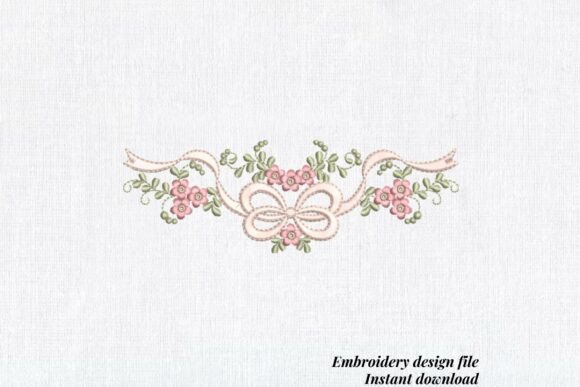
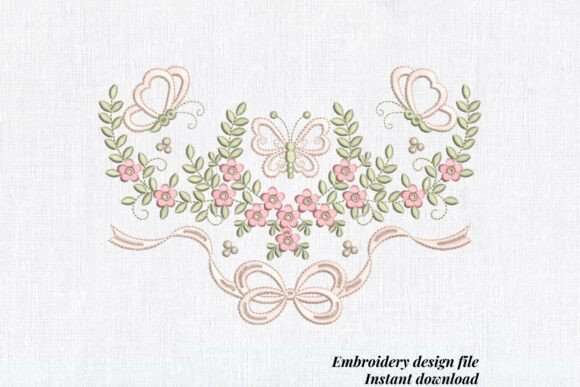
As an embroidery designer who’s stitched over 300 custom orders—from nursery wall hangings to boutique apparel—I approached the Floral Butterfly Border with quiet curiosity. Not hype, not urgency—just the kind of grounded evaluation I’d do before committing it to a client’s heirloom baby blanket or my own Etsy sweatshirt line. What stood out immediately was its romantic pastel mood: soft pink blossoms, slender greenery, and those elegant ribbon bows—delicate without being fragile, symmetrical without feeling rigid. It’s not a bold statement border; it’s a gentle frame. That distinction matters when you’re choosing machine embroidery design assets that reflect your brand’s voice.
Where This Border Naturally Belongs
The Floral Butterfly Border doesn’t shout—it invites. Its balanced layout makes it ideal for products where subtlety elevates intention: a linen kitchen towel folded neatly on a farmhouse counter, a cotton apron worn by a small-batch baker, or the hem of a muslin baby blanket gifted at a spring shower. I tested it digitally across several real-use mockups—including a curved cap edge and a tapered pillow cover—and found its symmetry holds beautifully even when scaled slightly smaller. Unlike some borders that lose definition at 3.5", this one retains legibility in the petals and wing veining thanks to thoughtful stitch placement—not just density, but stitch personality. You’ll see satin stitch defining ribbon edges, gentle fill stitch in blossoms, and fine running stitch for vine tendrils. It breathes.
Real-World Performance Across Fabrics & Forms
I ran practical tests before committing to customer work: first on midweight cotton twill (tote bag), then on brushed poly-blend sweatshirt fabric, and finally on lightweight rayon challis (for a boutique scarf). On stable fabrics, the Floral Butterfly Border stitched cleanly with standard tear-away stabilizer—no puckering, no thread breaks. On the stretchy sweatshirt, I added light cut-away + topping, and the ribbon bows held shape without distortion. On dark fabric? The soft pink thread palette reads clearly *if* you choose high-contrast thread—don’t assume default pastels will pop on navy or charcoal. Always test on scrap first.
For curved surfaces like caps or tapered pillow corners, I resized the border to 92% width and adjusted hoop placement to follow the curve—not forcing the design flat. It adapted gracefully. Tiny details (like butterfly antennae and bow loops) stayed crisp, though I recommend inspecting them post-stitch on any textured or napped fabric (e.g., terry cloth towels). Dense fill areas are moderate—not overly heavy—so it holds up well on items meant for frequent washing, like kitchen towels or children’s aprons.
Commercial Use & Brand Alignment
If you sell on Etsy or supply local boutiques, the Floral Butterfly Border quietly lifts perceived value. It reads as *hand-finished*, not mass-produced—especially when paired with natural fibers and minimalist product photography. I used it on a set of three linen napkins; customers commented on the “whisper of whimsy” in the border, not the stitching itself. That’s the sign of strong design integration: the embroidery supports the product, not overshadows it.
For personalized gifts—think monogrammed baby blankets or custom bridal party totes—the border frames initials or names elegantly without competing. And because it’s symmetrical, it works equally well on rectangular, square, or gently rounded edges. No awkward cropping or forced centering. That consistency helps maintain brand cohesion across seasonal listings, craft fair displays, or printable mockups you share with wholesale buyers.
Practical Notes Before You Stitch
Before downloading or stitching the Floral Butterfly Border, here’s what I always check:
- Hoop size: Confirm the design fits your most-used hoop—especially if you embroider on-site at craft fairs or use compact home machines.
- Stitch density: While not extreme, the floral clusters do layer subtly—verify your machine handles fine detail on lightweight stabilizer if working with silk or rayon.
- Thread colors: The pastel palette is lovely, but consider swapping one or two shades (e.g., deeper rose for contrast on cream linen) to match your brand palette.
- Licensing: Review the Creative Fabrica product page carefully—some embroidery files include commercial use rights, others don’t. Never assume.
- File details: Check included formats (.pes, .dst, .jef, etc.) for compatibility with your machine or digitizing software—especially if you plan to resize or combine with other designs.
Final Thoughts for Embroidery Designers & Small Business Owners
The Floral Butterfly Border won’t replace your go-to geometric or script borders—but it fills a specific, valuable niche: romantic, refined, and quietly versatile. It’s not flashy enough for streetwear, nor dense enough for heavy-duty workwear—but for handmade products rooted in care, nostalgia, or gentle celebration? It lands perfectly. I’ve added it to my core collection of Borders for nursery decor, bridal accessories, and spring-themed shop launches.
If your customers respond to tactile quality, intentional detail, and designs that feel *made for them*, not just made *on* them—the Floral Butterfly Border earns its place. Just remember: no digital embroidery file replaces testing. Run it on scrap fabric. Photograph it on your actual product surface. See how it moves with the drape, how it ages after a wash cycle, how it translates in natural light. That’s where the real review happens—not in the preview, but in the finished product.